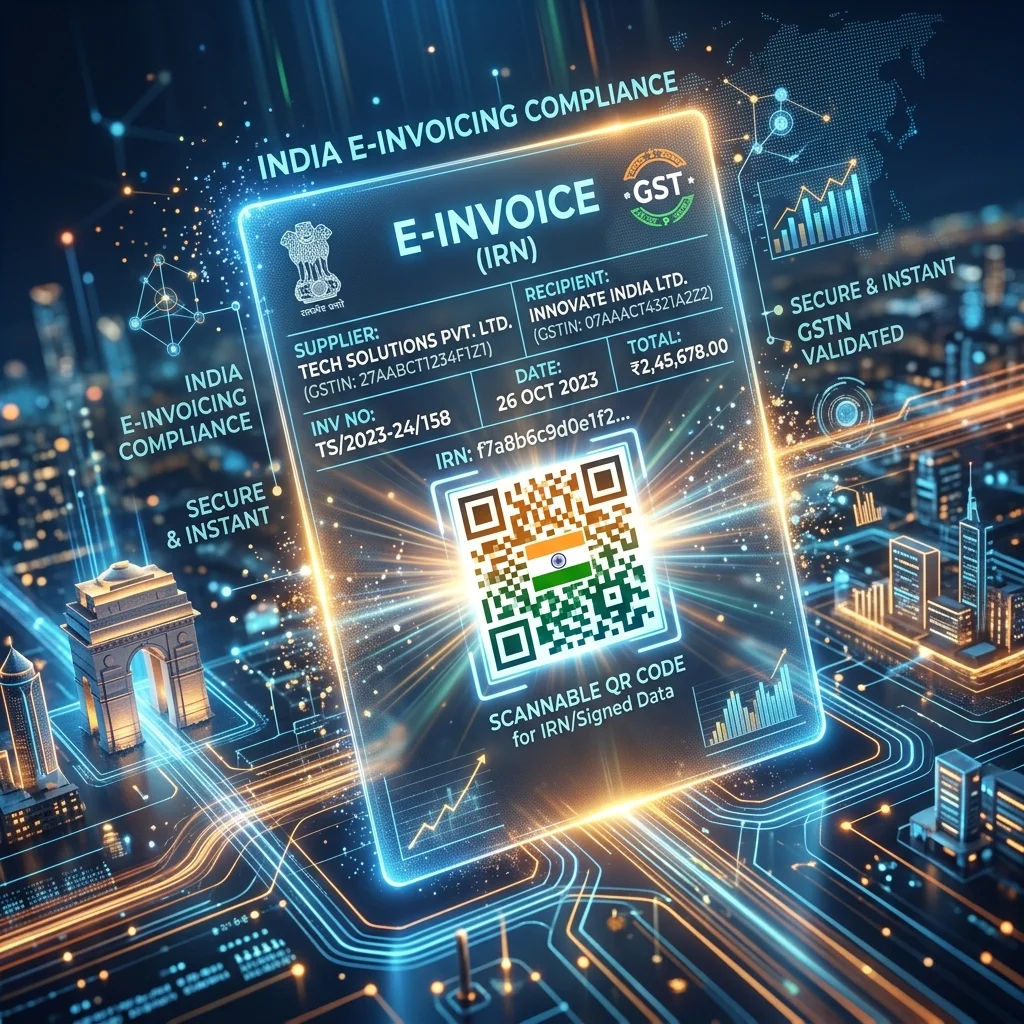
The Goods and Services Tax (GST) fundamentally reshaped how businesses operate in India. Gone are the days of fragmented state-level taxes and convoluted excise duties. However, with this unification came an unprecedented level of digital scrutiny. Today, a single formatting error on a GST invoice can lead to the denial of Input Tax Credit (ITC) for your clients, severe penalties from the GST Network (GSTN), and severe cash flow disruptions.
In 2026, compliance is no longer a human task—it is a computational necessity. If you are manually calculating SGST, CGST, or IGST on a spreadsheet, you are operating with an unacceptable level of risk.
"Tax compliance is the silent killer of scaling businesses. If your invoicing workflow requires manual tax calculations in 2026, you are not saving money; you are gambling with your operating license."
— Rohan Desai, Chartered Accountant & Financial Strategist
This ultimate guide will break down the exact anatomy of a compliant GST invoice, the critical differences between B2B and B2C billing, the intricacies of the new e-invoicing mandate, and how software platforms like BILLAZZ remove this entire burden from your shoulders.
1. What Exactly is a GST Tax Invoice?
A GST Tax Invoice is a primary legal document issued by a registered supplier to a recipient, detailing the goods or services provided and the exact amount of tax levied. It acts as the absolute proof of transaction and is the sole document that allows the recipient to claim Input Tax Credit (ITC).
Under Section 31 of the CGST Act, a registered person supplying taxable goods or services must issue a tax invoice showing the description, quantity, value of goods, the tax charged, and other prescribed particulars.
Pro Tip: Never issue a "Proforma Invoice" and expect payment in an official capacity. A Proforma is merely a quotation. Only a formal "Tax Invoice" carries the legal weight for tax remittance and ITC claims.
The Anatomy of a Perfect GST Invoice
To be legally valid under Rule 46 of the CGST Rules, your invoice must contain a minimum of 16 mandatory fields. Missing even one of these can render the invoice invalid.
- Your Legal Name, Address, and GSTIN: The supplier's exact details as registered on the GST portal.
- Consecutive Serial Number: The invoice number must be unique, contain only alphabets, numerals, or special characters (hyphen/slash), and cannot exceed 16 characters. (e.g.,
INV-26-0012). - Date of Issue: Crucial for determining the "Time of Supply" and tax liability.
- Recipient's Details: Name, address, and GSTIN (if registered).
- State Name & State Code: Essential for both the supplier and the place of supply.
- HSN or SAC Code: The Harmonized System of Nomenclature code for goods, or the Services Accounting Code for services.
- Description of Goods/Services: A clear, unambiguous description.
- Quantity & Unit: Required for physical goods (e.g., kg, meters, pieces).
- Total Value: The gross value of the supply.
- Taxable Value: The value after applying any discounts or abatements.
- Tax Rates: Clearly broken down into CGST, SGST, or IGST.
- Tax Amounts: The absolute numeric value of the tax levied.
- Place of Supply: Along with the name of the state (crucial for inter-state vs. intra-state determination).
- Reverse Charge Indicator: A simple "Yes" or "No" indicating if the tax is payable on a reverse charge basis.
- E-Way Bill Number: If applicable for the transportation of physical goods exceeding ₹50,000.
- Authorized Signature: Digital or physical signature of the supplier.
2. Intra-State vs. Inter-State Billing (CGST, SGST, IGST)
The most common mistake small business owners make is applying the wrong tax type. The GST framework is a dual-tax system, meaning the revenue is shared between the Central and State governments.
Determining which tax to apply depends entirely on the Place of Supply.
Intra-State Supply (Same State)
When the location of the supplier and the place of supply (the buyer) are in the same state or Union Territory.
- Taxes Applied: CGST (Central GST) + SGST (State GST)
- Example: A web design agency in Mumbai (Maharashtra) builds a website for a client in Pune (Maharashtra). The GST rate is 18%. The invoice must reflect 9% CGST and 9% SGST.
Inter-State Supply (Different States)
When the location of the supplier and the place of supply are in different states or Union Territories.
- Taxes Applied: IGST (Integrated GST)
- Example: That same web design agency in Mumbai builds a website for a client in Bangalore (Karnataka). The invoice must reflect a single 18% IGST charge.
The Export Trap: If you are an Indian freelancer billing a client in the USA or UK, you are engaging in an "Export of Service." Under GST law, exports are considered "Zero-Rated Supplies." You do not charge IGST, provided you have filed a Letter of Undertaking (LUT) with the government for that financial year. If you have not filed an LUT, you must charge IGST and claim a refund later—a massive headache you should avoid.
3. The 2026 E-Invoicing Mandate Explained
E-invoicing (Electronic Invoicing) is the process where B2B invoices are electronically authenticated by the GST Network (GSTN) for further use on the common GST portal.
Initially introduced in 2020 for mega-corporations with turnovers exceeding ₹500 Crores, the threshold has been systematically lowered. As of the latest 2026 mandates, every registered business with an aggregate annual turnover exceeding ₹5 Crores must generate e-invoices for their B2B transactions.
How E-Invoicing Works
Contrary to popular belief, e-invoicing does not mean you generate your invoice on the government portal. You continue to generate the invoice in your own billing software (like BILLAZZ).
The automated process looks like this:
- You create the invoice in BILLAZZ.
- BILLAZZ instantly transmits the raw JSON payload of that invoice to the Invoice Registration Portal (IRP).
- The IRP validates the data, generates a unique 64-character Invoice Reference Number (IRN), and digitally signs it.
- The IRP generates a QR Code containing critical invoice parameters.
- BILLAZZ receives this signed payload, embeds the QR code onto your PDF invoice, and emails it to your client.
This entire round-trip takes less than 300 milliseconds.
Why You Cannot Ignore E-Invoicing
If your turnover exceeds the threshold and you issue a standard, non-IRN invoice to a B2B client, that invoice is considered legally invalid.
- Your client cannot claim ITC on that invoice.
- You will be penalized ₹10,000 or 100% of the tax due (whichever is higher) per invoice.
The BILLAZZ Advantage: BILLAZZ acts as an approved GST Suvidha Provider (GSP) bridge. You simply connect your GSTIN in the settings dashboard, and every B2B invoice you create is automatically authenticated via the IRP in the background. You never have to deal with JSON payloads or manual portal uploads.
4. Comparison: Tax Invoice vs. Bill of Supply
It is crucial to understand that you do not always issue a Tax Invoice. If you fall under specific categories, you must issue a "Bill of Supply" instead.
| Parameter | Tax Invoice | Bill of Supply |
|---|---|---|
| Purpose | To collect tax and pass on ITC | Issued when tax cannot be collected |
| Issued By | Regular GST Registered Dealers | Composition Scheme Dealers or those supplying Exempt Goods |
| Tax Amount | Separately shown (CGST/SGST/IGST) | No tax is shown or collected |
| ITC Claim | Recipient CAN claim ITC | Recipient CANNOT claim ITC |
If you are a freelancer supplying services under the ₹20 Lakh exemption limit (and thus not registered for GST), you simply issue a standard commercial invoice, which effectively acts as a Bill of Supply.
5. Real Business Case Study: The 18% Margin Wipeout
TechNova Solutions, an IT consulting firm in Hyderabad, signed a ₹15 Lakh contract with a massive corporate client in Delhi. The gross invoice value, inclusive of 18% GST, was ₹17.7 Lakhs (₹2.7 Lakhs in tax).
TechNova’s junior accountant manually drafted the invoice in a Word template. Due to a copy-paste error from a previous invoice template, she accidentally applied CGST (9%) and SGST (9%) instead of the correct IGST (18%) for this inter-state transaction.
The Fallout:
- The corporate client in Delhi rejected the invoice immediately, as they could not claim ITC for Telangana state-level SGST.
- The payment was delayed by 45 days while the invoice was voided, credit notes were issued, and a new invoice was generated.
- TechNova’s cash flow was severely crippled, forcing them to take an emergency short-term loan at 14% interest to make payroll.
The Lesson: Manual invoicing is a ticking time bomb. Had TechNova used an automated billing platform, the system would have recognized the supplier state (Telangana) and the buyer state (Delhi), instantly and irrevocably locking the tax calculation to IGST.
6. Actionable Checklist for GST Compliance
If you are setting up your business billing workflow today, ensure you complete this checklist before sending your first invoice:
-
Verify your client's GSTIN using a portal verification tool.
-
Determine if the transaction is Intra-State or Inter-State.
-
Locate the exact 4-digit or 6-digit HSN/SAC code for your specific service.
-
Determine if your turnover requires mandatory E-Invoicing (IRN generation).
-
Confirm if your services require a Letter of Undertaking (LUT) for export zero-rating.
-
Switch from manual Word/Excel templates to a compliant SaaS platform like BILLAZZ.
Frequently Asked Questions
Do I need to print invoices in triplicate?
Yes, for the supply of physical goods, invoices must be prepared in triplicate (Original for Recipient, Duplicate for Transporter, Triplicate for Supplier). For the supply of services, it must be in duplicate (Original for Recipient, Duplicate for Supplier). However, digitally signed PDFs emailed directly circumvent the need for physical printing.
How do I correct a mistake on an already issued GST Invoice?
You cannot simply delete or edit a GST invoice once it has been uploaded to the GST portal or an IRN has been generated. You must issue a formal "Credit Note" against the original invoice to reverse the liability, and then issue a fresh, correct invoice.
Is a digital signature mandatory on a GST invoice?
Under Rule 46 of the CGST Rules, a signature or digital signature of the supplier or their authorized representative is mandatory. However, if you are generating invoices electronically under the Information Technology Act (which platforms like BILLAZZ facilitate), a physical signature is not required.
Can I round off the total invoice value?
Yes. Section 170 of the CGST Act states that the tax amount and total invoice value can be rounded off to the nearest Rupee (i.e., 50 paise and above is rounded up to the next Rupee).
Conclusion
Mastering GST invoicing is not about becoming a tax expert; it is about building robust systems that prevent human error from touching your cash flow. The Indian tax framework is highly digitized, sophisticated, and unforgiving of sloppy paperwork.
By leveraging automation, understanding the core concepts of supply location, and adhering to the strict e-invoicing mandates, you transform a massive compliance burden into a seamless, invisible background process.
Stop gambling with your company's financial health by using manual spreadsheets. Upgrade to a system that enforces compliance by default.
""Switching to BILLAZZ for our GST compliance was the single highest ROI decision we made this year. We used to spend 4 days a month on reconciliation. Now, it happens instantly in the background.""
Ready to Automate Your GST Compliance?
Join 10,000+ Indian businesses using BILLAZZ to automatically calculate GST, generate instant IRN e-invoices, and collect payments 3x faster.